

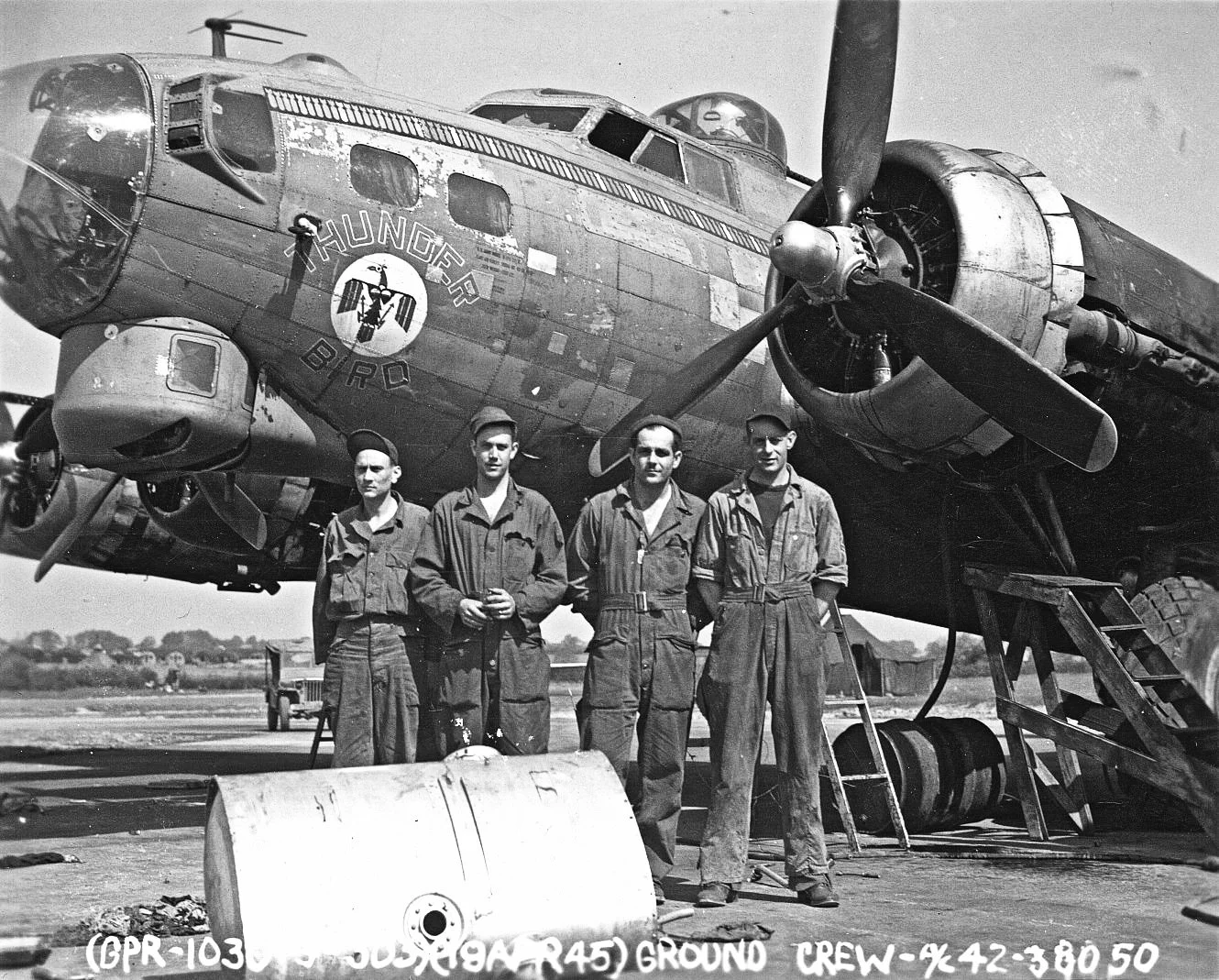
On January 29th, 1944, a newly assigned B-17G Flying Fortress named Thunderbird took off from RAF Molesworth, England, on her first combat mission. Her destination was Frankfurt, and all her crew wanted was to complete the mission and make it home.
Thunderbird did return home, albeit with severe flak damage to her left wing, including a direct hit to the main spar that required an entire wing replacement.
It was an inauspicious start for a Fortress that would go on to complete 112 credited combat missions.
A New Fortress on the Block
Built by Douglas Aircraft in Long Beach, California, B-17G-25-DL 42-38050 was assigned to the 359th Bomb Squadron of the 303rd Bombardment Group (Heavy), the Hell's Angels. Arriving at RAF Molesworth in January 1944, she was assigned to a crew led by Lieutenant Vern L. Moncur, who had already completed six missions.
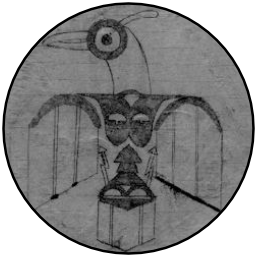
Their new Fort needed a name, and Moncur put Thunderbird forward, inspired by the Thunderbird of Native American mythology, associated with good fortune and protection.
‘(The Thunderbird ) is an Indian symbol for luck, and we sure will need it.’ - Lt. Vern Moncur
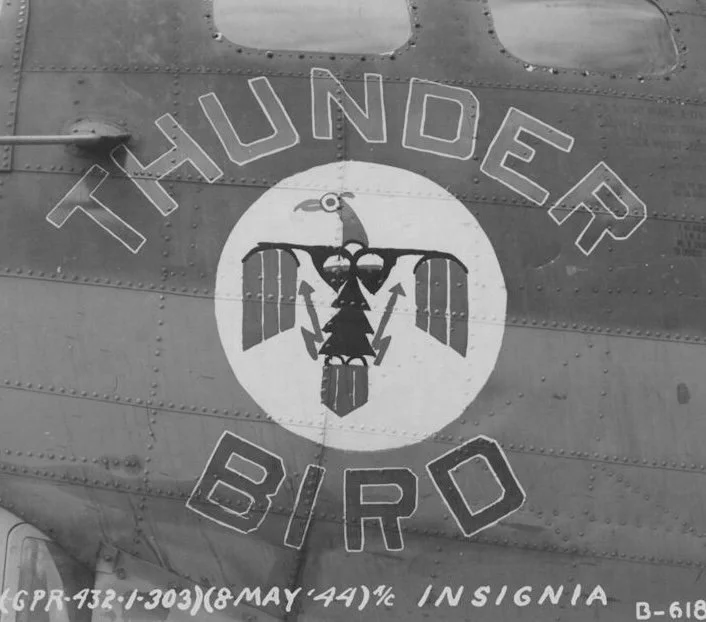
Thunderbird’s Nose Art
The crew's radio operator, James S. Andrus, produced the original sketch for the aircraft's nose art, which was the expertly adapted and painted onto the Fort’s Nose by Annie Haywood, an artist working with the American Red Cross Aero Club at Great Ashfield, home of the 385th Bomb Group.
The good-luck charm appeared to work. Lt. Moncur and his crew flew 20 combat missions aboard Thunderbird, completing their entire 28-mission combat tour without a single crew member being injured. That this occured during a period when American bomber crews faced devastating losses is remarkable.
After Moncur's crew completed their tour in April 1944, Thunderbird continued flying with other crews of the 303rd Bomb Group. Her fame as a fortunate Fortress began to grow, and Thunderbird became a “first mission ship”, carrying newly arrived crews on their initial combat sorties.
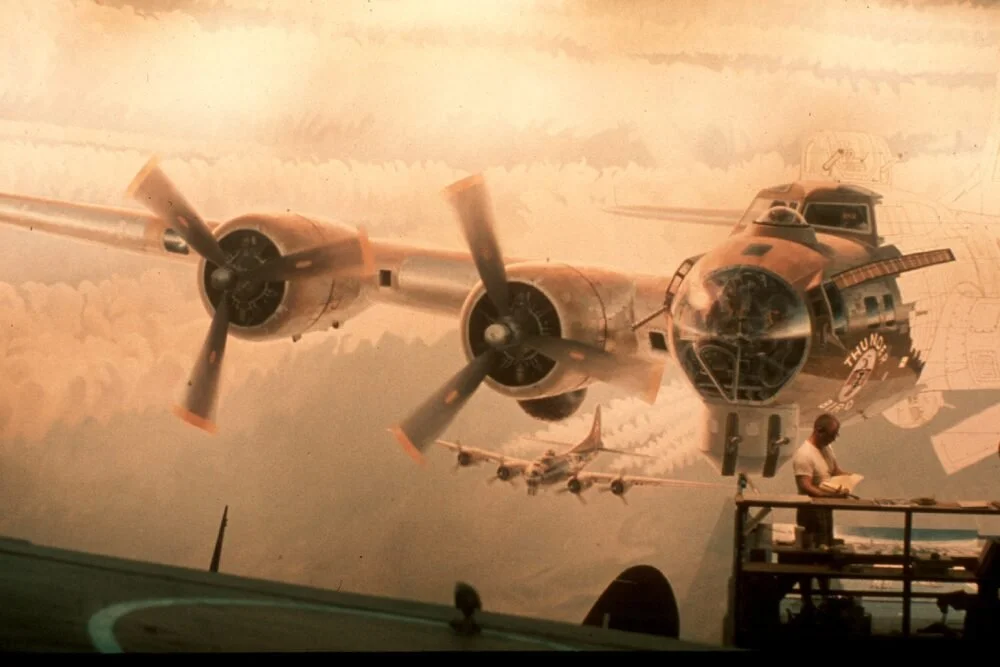
Her missions took her to targets including Berlin, Frankfurt and Schweinfurt. On one mission, she returned with an engine on fire. On August 15th 1944, she survived a fierce attack by German fighters while returning from a mission to Wiesbaden, during which the 303rd Bomb Group lost nine B-17s. The encounter would later be immortalised by aviation artist Keith Ferris in his enormous 25-by-75 ft mural, Fortresses Under Fire, at the Smithsonian National Air and Space Museum in Washington, D.C (the largest known aircraft painting anywhere in the world).
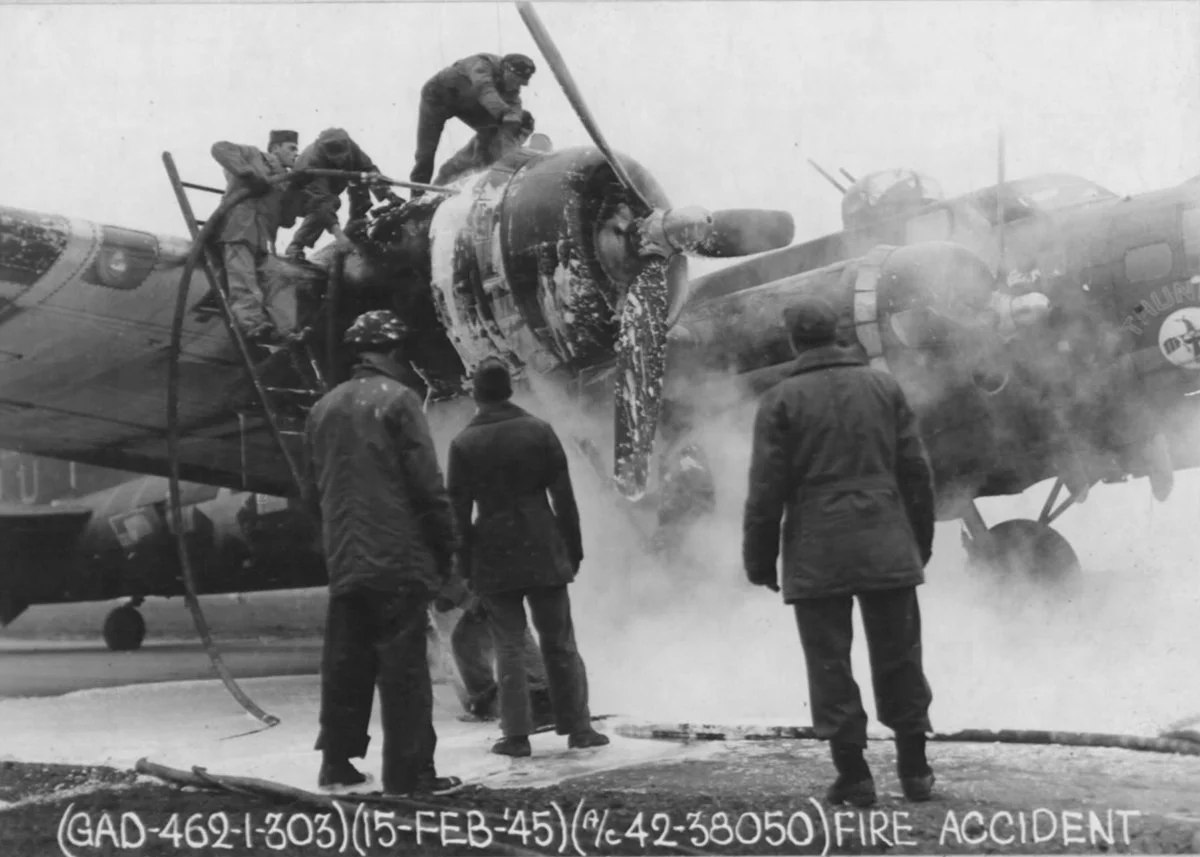
On 15 February 1945, following Thunderbird's 102nd combat mission, a raid on Dresden, ground crews were photographed tackling an engine fire on the veteran Fortress.
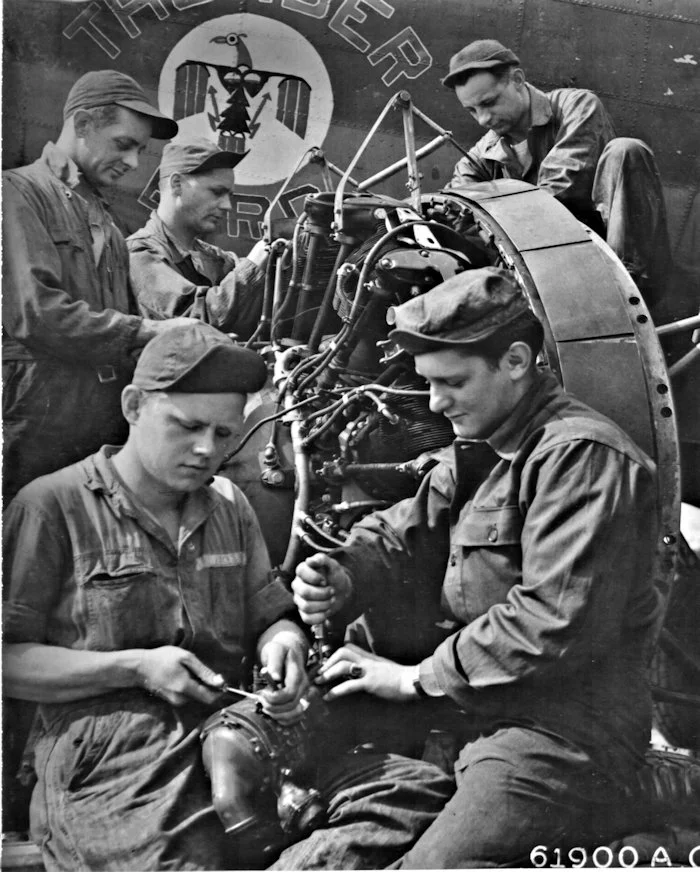
Behind this extraordinary record were the efforts of the ground crews, including Crew Chief James P. Thompson and his team. Often working through the night, their careful maintenance and repairs kept the increasingly battle-weary Fortress flying.
Thunderbird's Final Mission
On March 22nd 1945, with the war in Europe drawing to an end, Thunderbird flew her 112th and final credited combat mission.
The target was a German military camp near Buer, and the aircraft carried the newly arrived crew of Lt. Frederick A. Stewart, who flew as co-pilot alongside combat orientation pilot Lt. Merwin G. Hall. For Stewart's crew, it was their first combat mission. For Thunderbird, it was her last.
By the time she was withdrawn from combat operations, her appearance reflected the punishment of more than a year of constant service. Much of her paint had worn away and replacement panels and patches pockmarked her airframe.
The 303rd Bomb Group's records identify 538 airmen who flew aboard Thunderbird across 134 recorded flights, including her 112 credited combat missions. Remarkably, no regular crew member was recorded as having been injured on a Thunderbird mission.
Declared "war weary", she was retired from combat flying.
Although she had survived the war, Thunderbird would not survive the post-war disposal of surplus military aircraft. She was eventually flown to Kingman, Arizona, where she was scrapped on December 21st 1945.
Tribute Ship: B-17G 44-85718
B-17G 44-85718, operated for many years by the Lone Star Flight Museum in Texas, was painted in Thunderbird's wartime markings. In 2020, the aircraft was acquired by the Mid America Flight Museum and subsequently entered an extensive restoration programme. The Thunderbird livery has since been stripped, and the aircraft is expected to return to the skies wearing the livery of another fascinating B-17: We The People
Keeping Thunderbird's Story Alive
More than eight decades after her first combat mission, Thunderbird remains a symbol of the courage, endurance and sacrifice of the men who flew and maintained the B-17 Flying Fortress during the Second World War.
We wanted to commemorate this remarkable aircraft with a design that does justice to this remarkable aircraft.


Our B-17 Thunderbird T-Shirt features a hand-illustrated recreation of her original 1944 nose art. The Back-Print includes her production block (B-17G-25-DL), serial number 42-38050 and historic mission markings, while a smaller Left-Chest Print commemorates her 112 combat missions.
Sources:
303rd Bomb Group Website: Founded by Gary Moncur, son of Thunderbird's original pilot, Lt. Vern L. Moncur. This archive is an incredible resource, containing mission records, crew histories, original photographs and firsthand accounts: https://www.303rdbg.com/thunderbird/index.html
385th Bomb Group Association: This website was vital in determining the identity of Thunderbirds original Nose artist, Annie Haywood. She is incorrectly referred to as Anne Hayward is multiple other sources: https://www.385thbga.com/photos/nose-art/
Keith Ferris — Fortresses Under Fire
